Key Takeaways
- Automated samosa machines significantly increase production speed, helping businesses meet customer demands during peak times.
- Using a Samosa Making Machine Manufacturer in India ensures consistency in size, shape, and quality of samosas.
- Reduction in skilled labor dependency allows businesses to focus on other important kitchen tasks.
- Long-term cost savings emerge from automated production, minimizing raw material waste and reducing labor expenses.
- Maintaining high hygiene standards is easier with automated machines, reducing risk of contamination.
Samosa is one of the most popular snacks enjoyed across India and many international markets. From roadside stalls and restaurants to cafés, hotels, catering companies, and frozen food manufacturers, the demand for perfectly shaped and delicious samosas continues to grow every year. As customer expectations increase, businesses need faster production methods while maintaining product quality and hygiene. Traditional hand-made preparation requires considerable time, skilled labor, and continuous supervision, making it challenging to produce large quantities consistently.
Automation has transformed food manufacturing by helping businesses improve productivity without compromising the quality of the final product. An automatic Samosa Machine simplifies the production process by creating uniformly shaped samosas in significantly less time than manual preparation. Whether a business produces fresh or frozen samosas, automation helps streamline operations and improve efficiency.
As a trusted Samosa Making Machine Manufacturer in India, Penguin Engineering develops advanced food processing equipment designed to meet the growing requirements of commercial food producers. Businesses looking to expand production capacity while maintaining consistency increasingly prefer automated machinery to remain competitive in today's fast-moving food industry.
Significantly Faster Production
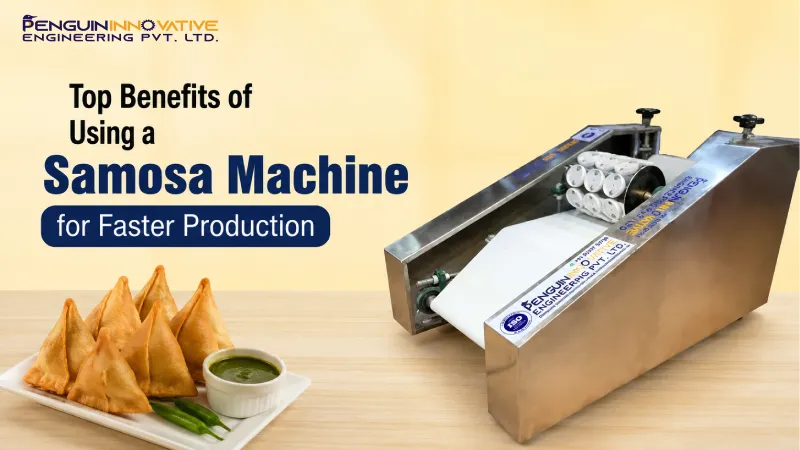
The most obvious and obvious is the speed with which a samosa machine works. A team of workers can take several hours to prepare by hand, but the automated equipment can do the job in a fraction of that time. The machines are made to roll, fill, fold and seal the dough continuously without any slowdowns and without breaks.
This speed can make the difference between a business being able to accommodate the orders placed during events such as festivals, and it causes them to fall short of their customers.Penguin Engineering's machines include multi-die machines, all designed to assist a food business to increase its production without having to increase the number of manual employees.
Consistent Size, Shape, and Quality
When ordering a samosa, the customer will expect the same taste and appearance. The manual folding process may result in uneven distribution of filling within each samosa, vary in sizes and not seal the samosa properly, causing some to split open during the frying process. A samosa machine gets rid of this variation altogether.
Each samosa made by the machine is the same size, the same filling and securely sealed. This kind of consistency leads to trust with the customers and helps minimize wastage of improperly sealed or torn samosas. This reliability is priceless for any brand aiming to present a product that is uniform in different outlets.
Reduced Dependency on Skilled Labor
It is often difficult to locate and keep employees to shape samosas rapidly and efficiently, particularly during peak seasons. A samosa machine lessens this dependence by taking care of the technical aspect automatically.
Years of experience are not required to operate the machine to its full potential; operators can be trained and get familiar with the machine, its production process, and the filling supply for the equipment and maintain production.This helps business owners to handle labor shortage and staffing issues better and prevents them from incurring production delays.
Lower Long-Term Operating Costs
A machine costs money to purchase but can have a positive long-term impact. Less labor equals less monthly wage costs and quicker production equals more samosa being produced and sold within the same number of hours. Less wastage from inconsistent shaping and sealing also means that the raw materials such as dough and filling are used better.These savings can accumulate over months and years of use, so automation is a good long-term investment and not just an upgrade to operations.
Better Hygiene and Food Safety
When working entirely without mechanical equipment, hygiene is one of the most important aspects of food production and can also be a significant challenge. The more that dough and filling come into contact with hands, the more likely there is to be contamination.
Automated machines reduce the direct contact with the food by people, and this helps maintain the hygiene level in the whole production line.As a trusted Samosa Making Machine Manufacturer in India, Penguin Engineering emphasizes hygiene-first automation in their designs, ensuring that businesses can create a cleaner and safer production environment that customers can trust.
Scalable Production for Growing Businesses
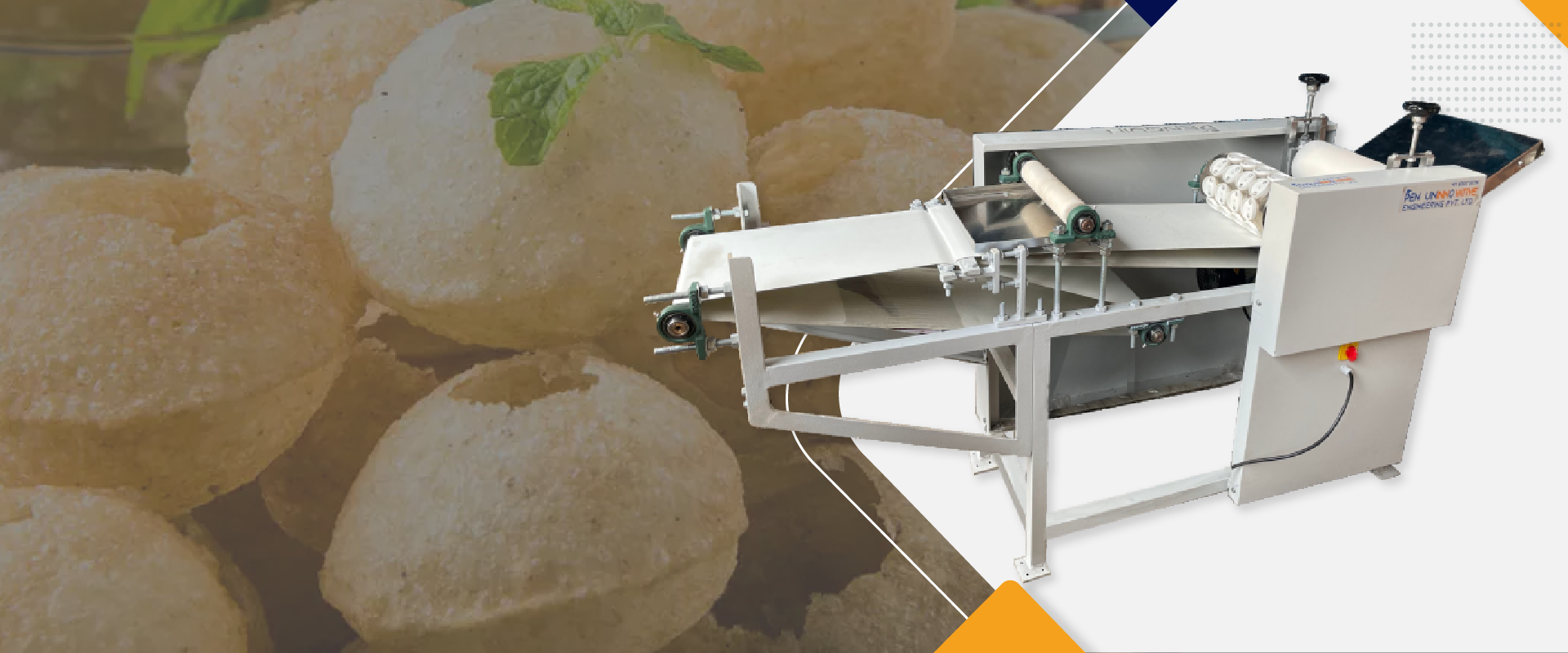
The most genius thing about investing in a samosa machine is the scalability. Penguin Engineering provides models that come in various die configurations including the 3-die, 4-die and 6-die models and multi-belt models for high capacity.
This allows for a simple setup that can then be expanded to a higher output model when demand dictates, yet without completely changing the basic kitchen configuration.This flexibility can help to make it easier to plan for growth rather than being constrained by production capacity.
Uniform Samosa Patti (Wrapper) Production
The wrapper is as much important as the filling. Pattis that are not evenly rolled or rolled too poorly may cause the samosa to not cook evenly or to fall apart when frying.
Patti making machines are specifically designed to make wrappers of uniform thickness and size, each time. This uniformity also translates to the finished product, ensuring even frying, aesthetically pleasing appearance and the appropriate shape of the samosa. It is also a good selling point for the businesses which supply samosa Patti separately to other vendors.
Durable Equipment Built for Daily Use
Commercial kitchens are under a huge amount of pressure, and they may be running equipment for hours, a day at a time. Machines that are constructed using long-lasting materials have been engineered to endure this sort of regular use without regular breakdowns.
This durability helps to minimize maintenance expenses and downtime, ensuring a seamless production process.Opting for the services of an established Samosa Making Machine Manufacturer in India is an investment in the machines that will last for a long time, and not be the ones that will need constant repairs or replacements.
Improved Workplace Efficiency
While workers spend hours packing samosas by hand, they can be engaged in other crucial activities like quality checks, packing, frying, or customer service.
This shift in work ensures greater efficiency of the kitchen and enables companies to maximize their staffing resources. Automation isn't only about making the process faster; it makes it more efficient!
Suitable for Multiple Business Types
There are no restrictions on the size of samosa machine that can be used. Penguin Engineering machines that are tailor-made for street food, small restaurants, catering and home-based businesses wanting to grow.
If it's a small machine for moderate production or a multi-belt machine for bulk production, there is a machine that's suitable for different business sizes and goals.
Choosing the Right Machine for Your Business
Selecting the right samosa machine depends on a few key factors: your expected daily production volume, available kitchen space, budget, and future growth plans. A small stall may only need a basic single-die machine, while a large commercial kitchen or export-focused unit may require a multi-die, multi-belt setup.
It is worth discussing your specific requirements directly with the manufacturer, so the equipment matches your actual production goals rather than choosing based on price alone. Penguin Engineering's team works with businesses to recommend suitable models based on real production needs, helping avoid the common mistake of underinvesting or overinvesting in equipment.
Why Choose Us
Penguin Engineering is a well-established name in the food machinery industry, based in Ahmedabad, Gujarat, and recognized for its focus on automation, hygiene, and reliable performance. As a dedicated Samosa Making Machine Manufacturer in India, Penguin Engineering offers a wide range of models, including samosa patti making machines with 3-die, 4-die, and 6-die configurations, along with multi-belt systems for higher production needs. Every machine is built from durable materials designed for daily commercial use, helping businesses reduce maintenance concerns while maintaining steady output. Penguin Engineering's approach centres on hygiene-first automation, giving business owners confidence that their production process meets high food safety standards. With a strong presence in the food processing machinery space and a reputation built over years of manufacturing experience, Penguin Engineering continues to support food businesses across India that want to modernize their kitchens, reduce manual dependency, and grow their production capacity with dependable, well-engineered equipment.
Conclusion
Automating samosa production brings clear advantages: faster output, consistent quality, better hygiene, and lower long-term costs. As demand for quick, reliable snack production grows across India, businesses that invest in the right equipment gain a real competitive edge. Penguin Engineering, a dependable Samosa Making Machine Manufacturer in India, offers a range of durable, hygiene-focused machines suited to businesses of every size. Choosing the right samosa machine is not just about speed; it is about building a stronger, more efficient, and more profitable food business for the future.
Ready to speed up your samosa production with reliable, hygienic automation? Contact Penguin Engineering today at +91 9510249096 or email info.penguinmech@gmail.com
Frequently Asked Questions

Mr. Aakash Gajjar
Founder & Owner, Penguin Innovative Engineering Company
A pioneering engineer with 101 student inventions, Aakash Gajjar has been revolutionizing food manufacturing since 1992. His iconic Smart Automatic Panipuri Machine earned prestigious state recognition by Honourable CM Shree Vijay Rupani at Khadhyakhorak 2018 and Honourable CM Shree Bhupendra Patel at Khadhyakhorak 2021, establishing Penguin Innovative Engineering as a true leader in food automation.